

Over the last decade, the front office of a travel agency has been rebuilt again and again with modern tools to quote trips, manage clients, and take payments online. But the finance tools for the agency back office, where commissions get reconciled and money gets paid out, is still stuck on decades-old systems.
That is not an exaggeration. TRAMS, the system that ran a large share of agencies’ financial back office for decades, was built in 1987. Its companion CRM, ClientBase, arrived in 1995. Those platforms market themselves with "40+ years of proven back-office expertise”, but the problem is that the software counting commissions was architected before the web existed, and hasn’t changed since.
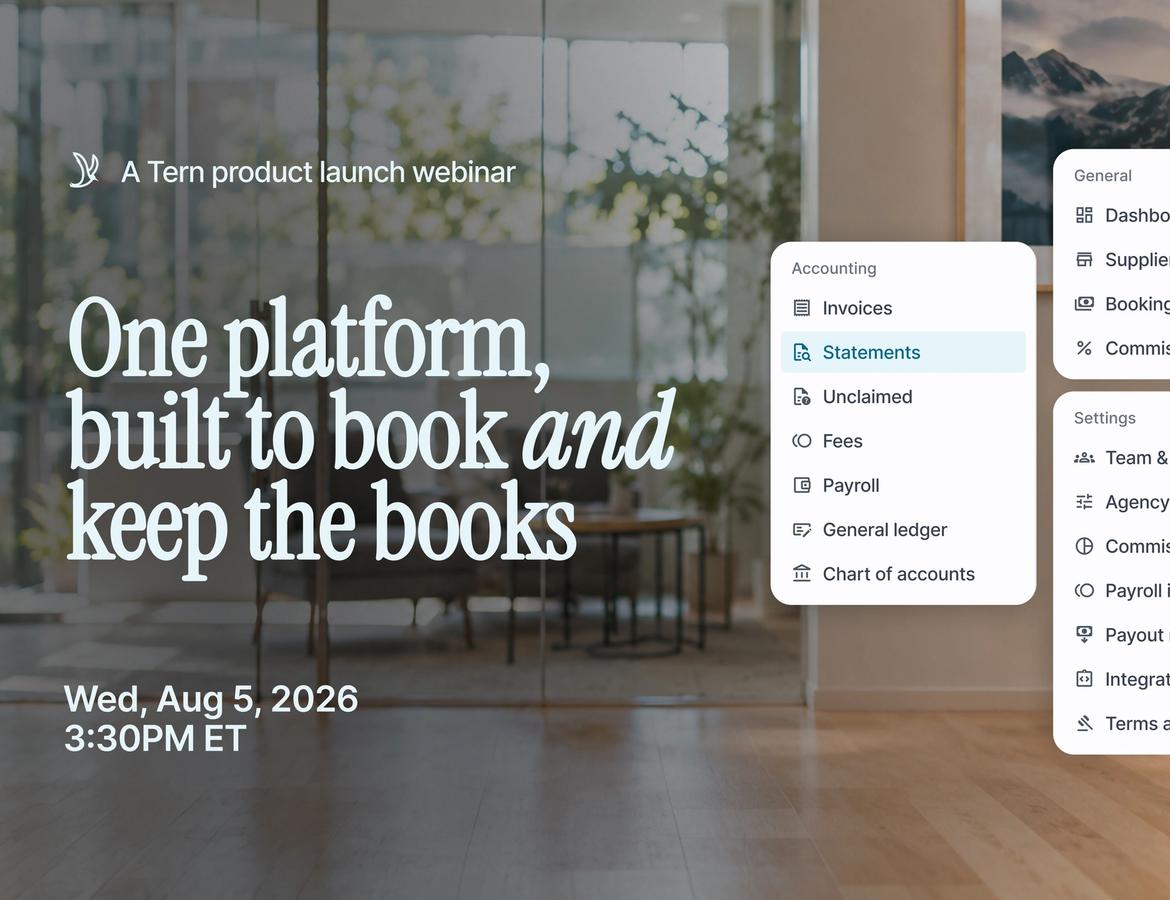
If your team is still reconciling commissions in a legacy back-office system like TRAMS/TRES or TESS, or stitching together point solutions like SION and TripSuite, we are hosting a live agency back office product launch webinar on August 5th. We will show how Tern is rebuilding the financial infrastructure travel agencies have been waiting for.
Month-end should not run on exceptions
If you own or operate a travel agency, you probably know this routine. A supplier statement comes in. Some bookings match cleanly. Others are missing, short-paid, overpaid, split across brands, or waiting on an payout logic that only your team knows how to apply. Before anyone gets paid, someone has to check the statement, confirm the booking, apply the right split, adjust the exceptions, answer the advisor questions, and make sure the books still tie out.
That work adds up quickly. One owner we work with keeps 4 separate spreadsheets a month just for theme parks, which pays across multiple different brands, then manually checks each reservation against supplier statements.
Another spends 4 to 5 hours a month building commission reports for her advisors, then fields disputes for days afterward. Her words: "Every month, it kills me. It's been upsetting me for 20 years."
At one large host agency, reconciliation required a dedicated team copying confirmation numbers out of PDF statements one line at a time.
This is not a training problem or a discipline problem. It is an architecture problem. Your team should not have to remember every exception, rebuild payout logic manually, or use spreadsheets as the connective tissue between the systems that are supposed to run the business.
Travel accounting is too complex for rigid tools
This work did not stay manual because agency owners failed to modernize. It stayed manual because travel accounting is unusually hard to standardize. A supplier can pay a different amount than expected, apply a retroactive promotion, short-pay a booking, split payment across brands, or delay payment until someone follows up. Then the agency still has to decide how that money should flow through its own advisor splits, fees, overrides, and reporting rules.
That variability is why TRAMS was the norm. It understood travel-specific workflows better than generic accounting software, so agencies adapted their back office around it. But it was built for a world where teams recorded and reconciled transactions after the fact, not one where owners expect real-time visibility and automatic matching. The result is that too much of month-end-close still depends on manual judgment.
Newer commission tools took the easier half of the problem instead. SION, the commission platform Bilt acquired for $30 million in early 2026, grew to more than 8,000 advisors by doing one thing well: tracking commissions and chasing suppliers for payment. That focus makes sense for Bilt, a consumer loyalty and payments company expanding into travel, but it also shows the limit of the approach. Its own founder is direct about the scope. "We're not here to be everything to everyone. We're here to solve commissions."
Streamlining commission reconciliation is very useful. But it is not the same as running the books. A commission tracker may help agencies see what is owed, but it does not replace the financial system underneath the business: chart of accounts, journal entries, audit trails, reporting, and the rules that determine how money moves from supplier payment to advisor payout.
Agencies that leave a legacy back-office system for a modern commission tool can still discover they need a real accounting system underneath it.
Tern connects reconciliation to the books
On August 5th we are showing what happens when the whole agency back office gets rebuilt in one place, next to the front office instead of bolted onto it.
It starts with the work you feel most acutely at month-end: reconciliation. Tern's AI commission reconciliation reads a supplier statement and matches it against open bookings automatically. A 20-item statement that took more than 20 minutes to reconcile by hand now clears in about 30 seconds.
But the bigger shift is what happens after a statement matches. Tern lets agencies configure the commission rules that determine how each advisor gets paid. So supplier rules, split structures, exceptions, and overrides can be set up once and applied automatically when the commission comes in. The goal is not just to match line items faster. It is to make the correct payout happen without someone rebuilding the logic manually each time.
That is why Tern has built the part no one else in travel has built: a true double-entry general ledger that is native to the front end tools their advisors use. Reconcile a statement and the corresponding ledger entry follows. This is the layer commission tools skip and the reason agencies kept a second system. It is built to the standard a real auditor will hold it to.
Once the books are native, the surrounding workflows can finally stop living in spreadsheets. Supplier payout rules can flow into payroll that generates a bank-ready NACHA file instead of a hand-assembled one. Overdue commission can flow into outbound invoicing, including a one-click way for an advisor to invoice a supplier directly. And because advisor-facing commission visibility is tied to the same financial system, advisors can see what is unclaimed, past due, or ready for payout.
Put together, it means your agency does not have to run a commission tool beside a general ledger beside a CRM beside a quoting tool. Advisors enter data once. It flows to the books once. The month-end close gets faster, the errors go away, and the second system becomes unnecessary.
Modern agencies will close faster
Every large industry eventually gets its own operating system, and the companies that build it win the decade. Toast did it for restaurants and now runs $195 billion in annual payment volume. Shopify did it for retail, where merchant services are now nearly three-quarters of its revenue. In each case the pattern was the same: not a better point tool, but one system that runs the whole business, with the money at the center.
Travel has been waiting for that system while its back office ran on software older than most of the advisors using it. If you are still spending month-end checking statements, adjusting splits, answering advisor questions, and reconciling the same information across multiple systems, that work is not a cost of doing business. It is a sign the system underneath the work is ready to change. The agencies that consolidate onto modern infrastructure over the next 3 years will close their books in hours, not weeks, and spend the time they get back on clients. That gap is about to get very visible.
We will show all of it live on August 5th. Register now.